How It
Works
MineHarvest Lunar Helium-3
Robotic harvesters collect regolith, and a solar-heated plant releases and captures the helium-3 the solar wind left in it.
ReturnShip It Home
Canisters ride a lander to lunar orbit and the Stellar Shuttle back to Earth.
ResearchTest Four Paths at Once
Launch revenue funds four fusion labs in parallel, one for each leading approach.
DeployCity Block Sized Plants
The first approach to work becomes a modular plant built from factory-made reactor modules.
Our Fusion
Goal
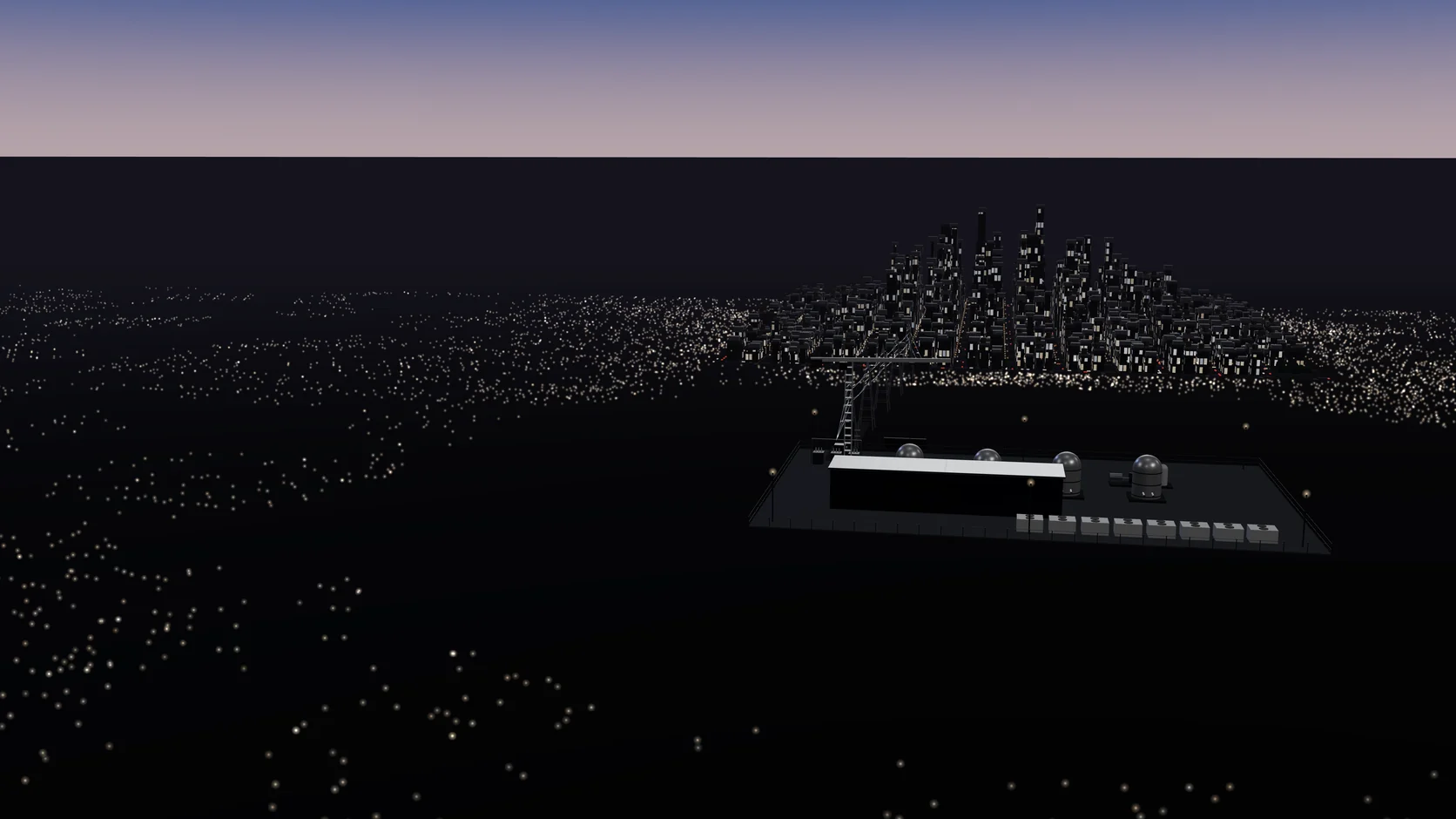
Our goal is to develop modular fusion power plants: compact reactor modules built on a factory line, delivered by truck and installed side by side, so a plant can start small on the edge of a city and grow with it.
We are not there yet, and neither is anyone else. No fusion approach has produced net electricity, and we make no claims about when one will. What we can do is fund research across four approaches at once and design a plant that is ready for whichever one works first.
Inside a
Modular Plant
01Plasma Chamber
A sealed vacuum vessel where fuel is heated into a plasma far hotter than the core of the Sun, hot enough for nuclei to fuse.
02Magnets
Superconducting coils wrap the chamber and hold the plasma away from its walls. In a laser or pulsed design, this job is done by compression instead.
03Lithium Blanket
A layer around the chamber absorbs the energy that escapes the plasma and turns it into heat. With deuterium-tritium fuel, the lithium also breeds new tritium.
04Heat Exchanger
A coolant loop carries the blanket's heat out of the module and boils water into high-pressure steam.
05Turbine and Generator
The steam spins a turbine, and the turbine drives a generator, the same proven equipment used in power plants today.
06Factory-Built Modules
Each reactor module is built on a factory line, trucked to the site and craned into place. A plant starts with a few modules and adds more side by side as demand grows.
The Four
Fusion Paths
Lab 1Tokamak
A doughnut of plasma held by magnets. The most studied approach; ITER, a large international tokamak, is under construction in France, and several companies are building compact versions.
Lab 2Stellarator
Twisted magnets that hold plasma without a large plasma current. Germany's Wendelstein 7-X has run long, stable plasmas, and companies are designing commercial versions.
Lab 3Inertial (Laser)
Lasers compress a tiny fuel pellet. In 2022 the National Ignition Facility produced more fusion energy from a target than the laser energy delivered to it, though the facility as a whole still uses far more energy than it makes.
Lab 4Magneto-Inertial
Magnetized plasma squeezed in fast pulses. Several companies are building pulsed machines; none has yet produced net energy.
The Fuel, in PerspectiveFusion fuel that would roughly fill the bed of a long-bed pickup truck could supply New York City's electricity for about a year.1
1 Our estimate. Assumes near-term deuterium-tritium fuel carried as lithium-6 deuteride, with the tritium bred from its lithium (about 22.4 MeV per lithium-6 deuteride, or about 2.7 × 10¹⁴ joules per kilogram), full burnup, 40 percent conversion of fusion heat to electricity, and New York City electricity use of about 54 terawatt-hours a year (New York Independent System Operator figure, as cited in a NOAA-hosted study of New York City building energy use). That is about 1.8 tonnes of fuel, roughly 2.2 cubic meters at 0.82 grams per cubic centimeter, about the volume of a full-size pickup's 8-foot bed, though heavier than such a truck is rated to carry. Helium-3 is the long-term fuel for deuterium-helium-3 fusion; it is a gas and would not fit in that volume, so this comparison is for deuterium-tritium fuel.
Why It
Matters
CostLow-Cost Clean Energy for All
Fusion makes no carbon emissions and its fuel is abundant, so power could become cheap enough for every home and business to use as much as it needs.
JobsEnergy Made in America
Labs, factories and plants built and run in the United States bring skilled jobs home and move energy production onto American soil.
SecurityFewer Conflicts Over Oil and Gas
A country that makes its own abundant energy depends less on oil and natural gas, and has fewer reasons to fight over them.
WaterFresh Water Through Desalination
Desalination is limited mostly by the cost of energy. Cheap, clean power could make seawater a reliable source of drinking water.
SupplyEasing Energy Shortages
Demand for electricity keeps climbing. Modular plants added where power runs short could help address energy shortages without straining the grid.
ScalePlants Where Power Is Needed
A plant the size of a city block, built from factory-made modules, can go up close to the people and industries it serves.
Shuttle and
Lightning
FundingLaunch Pays for Fusion
Lightning, our fully reusable launcher flying twice a week, is the business that would fund the labs. A major share of future launch cash flow goes to fusion.
AccessLightning Reaches Orbit
Harvesters, plant modules and landers for the Moon would leave Earth on Lightning, the same rocket that serves satellite customers.
TransportThe Shuttle Goes Further
The Stellar Shuttle, a reusable deep-space tug refueled in orbit, carries helium-3 home from lunar orbit.
Early-stage concept: Stellar Energy is a long-term vision, not a product in development. No fusion approach has yet produced net electricity on a commercial scale, no labs, sites, partners or funding are in place, and no dates or costs are claimed. Lunar helium-3 is very scarce and would require processing very large amounts of regolith. Future concept. Illustrative animation. Early-stage concepts under study. Not a commitment to build or sell any product.